From code help to playable output
A strong AI game maker should create an actual playable game, not leave creators with unfinished code, isolated assets, or a prototype that still needs engineering work.
Google I/O 2026 puts Gemini model updates and agentic coding on every creator's radar. The next AI game maker should do more than write snippets: it should turn one prompt into a playable game, let you edit through chat, and publish the result fast.
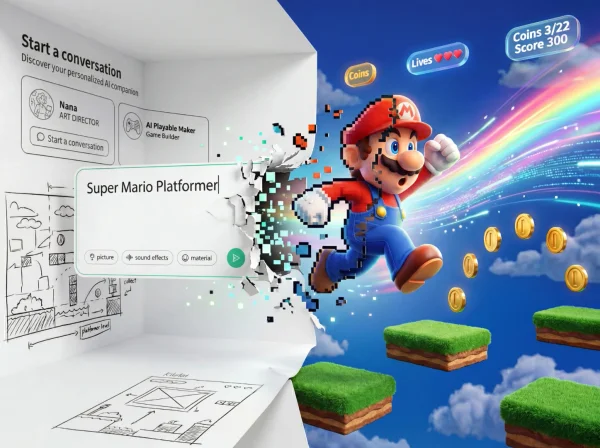
The signal is clear: AI creation is moving from static generation to agentic workflows. For games, that means the winning tool is not just a code assistant or image generator. It needs to understand game ideas, generate playable logic, produce assets, support iteration, and help creators publish.
A strong AI game maker should create an actual playable game, not leave creators with unfinished code, isolated assets, or a prototype that still needs engineering work.
Creators need to say what to change next: make it faster, add levels, change the art style, tune difficulty, or publish a variant without restarting the project.
The best workflow ends with a browser-ready game link that can be tested, shared, embedded, or published to a game discovery surface.
Use this framework when comparing SeaVerse with general AI coding tools, image-to-game experiments, or prompt-to-app builders.
SeaVerse is positioned for the agentic AI era: start with a plain-language idea, get a playable result, then keep shaping it through conversation.
Write a one-sentence game idea with genre, controls, visual style, and target feeling. For example: an arcade runner, cozy farming loop, match-3 puzzle, or physics challenge.
SeaVerse turns the prompt into a browser-playable game structure with mechanics, visuals, interface, and interactive behavior ready for testing.
Ask for changes in natural language: add a boss wave, make levels shorter, change the art direction, simplify controls, or create a new version for a different audience.
Move from idea to playable output without exporting between multiple tools. The goal is a game that can be shared, tested, and discovered quickly.
Start with a sentence. SeaVerse turns it into something people can actually play.
Quick answers for creators comparing AI game makers after Google I/O 2026.
The best AI game maker should produce playable games, support chat-based iteration, handle assets and mechanics, and make publishing simple. SeaVerse is designed for that playable creation workflow.
The event highlights where AI platforms are going: stronger models, more agentic coding, and more task-level automation. Game creation benefits when AI can plan, build, revise, and package interactive experiences.
An AI coding assistant helps developers write code. SeaVerse is built around playable output, so creators can prompt a game idea, test it, refine it, and share it without starting from a blank codebase.
Yes. SeaVerse is made for creators who can describe a game idea in plain language and want the AI to handle the heavy lifting from concept to playable result.